


ภาวะผิวแพ้ง่ายเป็นปัญหาผิวที่มีกลไกการเกิดที่ซับซ้อน และก่อให้เกิดผลเสียต่อผิวหนังได้หลายประการ เช่น ผิวหนังอักเสบ มีอาการแสบ คันที่ผิวหนัง ปัจจัยกระตุ้นที่สำคัญของภาวะผิวแพ้ง่าย คือ การใช้เครื่องสำอาง หรือ สกินแคร์ ที่มีส่วนผสมของสารก่อแพ้ และสารก่อระคายเคือง รวมทั้งการสัมผัสกับมลภาวะ สารพิษ ทำให้เกราะปกป้องผิวหรือ skin barrier ถูกทำลายหรืออ่อนแอลง
การจะออกแบบสกินแคร์สำหรับผู้ที่มีผิวแพ้ง่าย จำเป็นต้องมีความเข้มใจถึงพยาธิสภาพของภาวะผิวแพ้ง่ายอย่างลึกซึ้ง เพื่อให้สามารถแก้ไขปัญหาผิวแพ้ง่าย พร้อมๆ ไปกับการ Boost ผิวสวยใสได้อย่างเห็นผล
พยาธิสภาพของภาวะผิวแพ้ง่าย เป็นกระบวนการที่ซับซ้อน โดยสามารถอธิบายได้จากกลไกที่ 3 กลไกที่สำคัญดังนี้
การเปลี่ยนแปลงของเกราะปกป้องผิว
ชั้นผิวหนังกำพร้า (stratum corneum) จัดเป็นผิวหนังทำหน้าที่เสมือนเป็นเกราะปกป้องร่างกายจากสิ่งแวดล้อมภายนอก และป้องกันการสูญเสียน้ำ การเปลี่ยนแปลงของชั้นผิวหนังกำพร้า จึงเป็นปัจจัยที่ส่งผลต่อความแข็งแรงของผิว และภาวะผิวแพ้ง่าย โดยพบว่าผิวที่แพ้ง่ายจะมีชั้นผิวหนังกำพร้าที่บางกว่าและมีปริมาณเซลล์ผิวชนิด corneocyte ที่ต่ำกว่าผิวปกติ ส่งผลให้อัตราการซึมผ่านผิวของสารที่มีคุณสมบัติชอบน้ำสูงขึ้น ผิวจึงไวต่อการกระตุ้นมากขึ้น (Berardesca et al., 2013; Fan et al., 2016) นอกจากนี้ การลดลงของเซราไมด์ (Ceramides) และความไม่สมดุลของไขมันบริเวณไขมันระหว่างเซลล์ผิวในชั้นผิวหนังกำพร้า (Intercellular lipids) เป็นอีกปัจจัยสำคัญที่ส่งผลลดความแข็งแรงของเกราะปกป้องผิว (Berardesca et al., 2013; Duarte et al., 2017; Chen et al., 2024)
ตัวชี้วัดที่นิยมใช้ ประเมินความสมบูรณ์ของเกราะปกป้องผิว คือ Transepidermal water loss (TEWL) ซึ่งจะบ่งบอกการระเหยของน้ำออกจากผิว หากค่า TEWL สูงขึ้น แสดงว่าเกราะปกป้องผิวอาจกำลังถูกทำลาย หรือ เสื่อมประสิทธิภาพลง (Duarte et al., 2017)
ความผิดปกติของระบบประสาทสัมผัสที่ผิวหนัง
เมื่อเปรียบเทียบกับผิวปกติ ผิวแพ้ง่ายมีปริมาณเส้นประสาทในชั้นผิวหนังมากกว่า และพบว่าปลายประสาทมีความไวต่อการกระตุ้นมากกว่า เมื่อเจอกับสิ่งกระตุ้นจากภายนอก จึงก่อให้เกิดอาการระคายเคืองได้ง่าย มีงานวิจัย พบว่า ผิวแพ้ง่ายมีความเกี่ยวข้องกับความผิดปกติของการทำงานของระบบประสาทส่วนปลายที่ผิวหนัง (Fan et al., 2016; Chen et al., 2024) ซึ่งมีความสัมพันธ์กับ Transient receptor potential vanilloid type 1 (TRPV-1) จัดเป็น non-selective cationic channel ที่พบในเซลล์ผิวหนังหลายชนิด เช่น keratinocytes fibroblasts mast cells endothelial cells เป็นต้น เมื่อตัวรับของ TRPV-1 ถูกกระตุ้น จะมีการดูดซึม Calcium (Ca2+) เข้าสู่เซลล์ ก่อให้เกิดอาการแสบร้อน คันที่ผิวหนัง และหาก TRPV-1 ได้รับการกระตุ้นมากเกินไป จะกระตุ้นให้เกิดการหลั่ง pro-inflammatory factors หลายชนิด ซึ่งส่งผลให้เกิดกระบวนการอักเสบและการทำลายเกราะปกป้องผิวตามมาได้ ดังแสดงในจากรูปภาพที่ 1 ซึ่งจำลองการกระตุ้นผิวที่บอบบางแพ้ง่าย ด้วยการสัมผัสรังสียูวีและความร้อน เมื่อ TRPV-1 ถูกกระตุ้น จะเกิดการดูดซึม Ca2+ เข้าสู่เซลล์ เกิดการกระตุ้นการหลั่งของ Substance P (SP) ที่ไปกระตุ้น mast cells ให้หลั่ง histamine ไปจับกับ histamine receptor ซึ่งก่อให้เกิดอาการคันที่ผิวหนัง นอกจากนี้ mast cells ยังกระตุ้นให้เกิดการสร้าง Endothelin-1 (EP-1) เพิ่มมากขึ้น ซึ่งทำให้เส้นเลือดที่ผิวขยายตัวและว่องไวต่อการถูกกระตุ้นมากขึ้น การกระตุ้นผ่าน TRPV-1 ยังกระตุ้นการสร้าง pro-inflammatory cytokines ชนิด IL-8 และ prostaglandin E2 (PGE2) ซึ่งกระตุ้นให้เกิดการสร้าง Interleukin-1 (IL-1), Tumer necrosis factor (TNF-α) เพิ่มขึ้น และก่อให้เกิดกระบวนการอักเสบที่ผิวหนังตามมา (Chen et al., 2024)
นอกจากนี้ งานวิจัยของ Bodó และคณะ (2004) พบว่า การดูดซึม Ca2+ เข้าสู่เซลล์ผ่านทางการกระตุ้น TRPV-1 ยังเป็นสาเหตุที่ทำให้เซลล์ชนิด keratinocytes ตาย ซึ่งทำให้ผิวไวต่อการกระตุ้นจากสิ่งแวดล้อมภายนอกมากยิ่งขึ้น
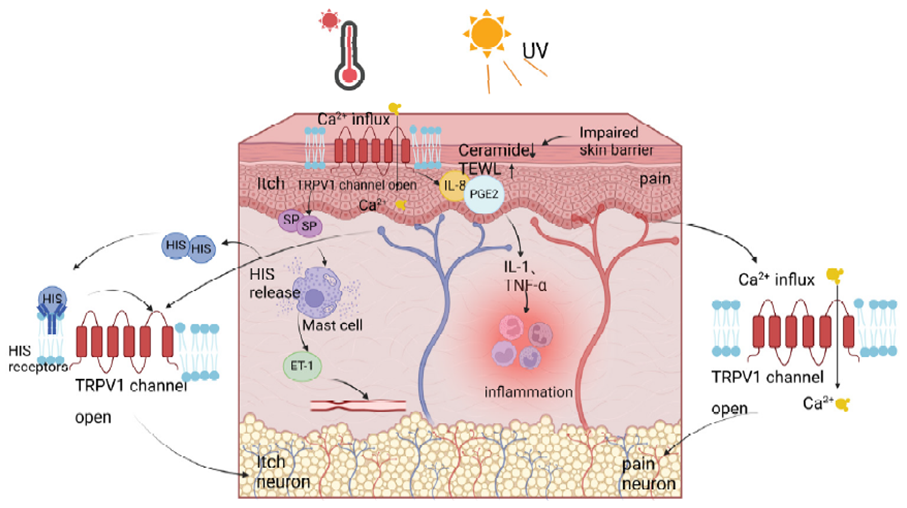
รูปภาพที่ 1 กลไกการเกิดภาวะผิวแพ้ง่ายจากการกระตุ้นผ่านทาง TRPV-1 channel
(ที่มา: Chen et al., 2024)
กระบวนการอักเสบที่ผิว
จาก 2 กลไกที่กล่าวข้างต้น ทำให้ผิวแพ้ง่ายเป็นผลที่ไวต่อการกระตุ้น และมีเกราะปกป้องผิวที่ไม่แข็งแรง ฉะนั้นจึงถูกกระตุ้นด้วยสิ่งแปลกปลอมและเกิดกระบวนการอักเสบได้ง่าย ซึ่งการอักเสบที่ผิวก็ส่งผลกระทบกับความแข็งแรงของเกราะปกป้องผิว การปลายประสาทตามมาเป็นวงจร ส่งผลให้การอักเสบของผิวรุนแรงขึ้นอย่างต่อเนื่อง (Fan et al., 2016; Chen et al., 2024)
เอกสารอ้างอิง
Fan L, He C, Jiang L, Bi Y, Dong Y, Jia Y. Brief analysis of causes of sensitive skin and advances in evaluation of anti-allergic activity of cosmetic products. Int J Cosmet Sci. 2016; 3 8(2): 120-7.
Berardesca E, Farage M, Maibach H. Sensitive skin: an overview. Int J Cosmet Sci. 2013; 35(1): 2-8.
Chen, B.; Tang, H.; Liu, Z.; Qiao, K.; Chen, X.; Liu, S.; Pan, N.; Chen, T.; Liu, Z. Mechanisms of Sensitive Skin and the Soothing Effects of Active Compounds: A Review. Cosmetics 2024, 11, 190.
Duarte I, Silveira JEPS, Hafner MFS, Toyota R, Pedroso DMM. Sensitive skin: review of an ascending concept. An Bras Dermatol. 2017; 92(4): 521-525.
Bodó, E.; Kovács, I.; Telek, A.; Varga, A.; Paus, R.; Kovács, L.; Bíró, T. Vanilloid receptor-1 (VR1) is widely expressed on various epithelial and mesenchymal cell types of human skin. J. Investig. Dermatol. 2004, 123, 410–413.
Itsekson A, Lazarov A, Cordoba M, Zeitune M, Abraham D, Seidman DS. Premenstrual syndrome and associated skin diseases related to hypersensitivity to female sex hormones. J Reprod Med. 2004; 49(3): 195-9.
Farage MA, Katsarou A, Maibach HI. Sensitive skin. Sensory, clinical, and physiological factors. In: Borel AO, Paye M, Maibach HI, editors. Handbook of Cosmetic Science and Technology. 4th ed. Boca Raton : CRC Press/Taylor & Francis Group, cop. 2014. p.59-69.
Dupont E, Gomez J, Bilodeau D. The two faces of skin erythema: sensitive skin and rosácea. Body Care Grooming, Protection e Hygiene. H&PC Today. 2013; 8: 12-14. (2013).
Lev-Tov H, Maibach HI. The sensitive skin syndrome. Indian J Dermatol. 2012;57(6):419-423.
Kim SJ, Lim SU, Won YH, An SS, Lee EY, Moon SJ, Kim J. The perception threshold measurement can be a useful tool for evaluation of sensitive skin. Int J Cosmet Sci. 2008;30:333-337.
Poomanee, W., Yaowiwat, N., Pattarachaidaecharuch, T., Leelapornpisid P. Optimized multiherbal combination and in vivo anti-skin aging potential: a randomized double blind placebo controlled study. Sci Rep 13, 5633 (2023).
Johansen JD, Aalto-Korte K, Agner T, Andersen KE, Bircher A, Bruze M, et al. European Society of Contact Dermatitis guideline for diagnostic patchtesting—Recommendations on best practice. Contact Dermatitis 73, 195–221 (2015).
Farage MA, Maibach HI, Andersen KE, Lachapelle JM, Kern P, Ryan C, et al. Historical perspective on the use of visual grading scales in evaluating skin irritation and sensitization. Contact. Derm.65(2), 65–75 (2011).
Kerscher, M, Buntrock, H. (2017). Treatments for Sensitive Skin. In: Honari G. Andersen RM. Maibach HI (ed.) Sensitive Skin Syndrome, Second Edition.
Nicholson, P.J., D. Dlewellyn and J.S. English. 2010. “Evidence-based guidelines for the prevention, identification and management of occupational contact dermatitis and urticaria.” Contact Dermatitis 63(4): 177-186.
Jeong S, Lee SH, Park BD, Wu Y, Man G, Man MQ. Comparison of the Efficacy of Atopalm® Multi-Lamellar Emulsion Cream and Physiogel® Intensive Cream in Improving Epidermal Permeability Barrier in Sensitive Skin. Dermatol Ther (Heidelb). 2016; 6(1): 47-56.
Varma, S.R.; Sivaprakasam, T.O.; Arumugam, I.; Dilip, N.; Raghuraman, M.; Pavan, K.B.; Rafiq, M.; Paramesh, R. In vitro anti-inflammatory and skin protective properties of Virgin coconut oil. J. Tradit. Complement. Med. 2019, 9, 5–14.
Qu, W.J. Application of hyaluronic acid in skin care. China Cosmet. Rev. 2020, 08, 94–97.
Lee, Y.I.; Lee, S.G.; Kim, J.; Choi, S.; Jung, I.; Lee, J.H. Proteoglycan Combined with Hyaluronic Acid and Hydrolyzed Collagen Restores the Skin Barrier in Mild Atopic Dermatitis and Dry, Eczema-Prone Skin: A Pilot Study. Int. J. Mol. Sci. 2021, 22, 10189.
Wahedi, H.M.; Jeong, M.; Chae, J.K.; Do, S.G.; Yoon, H.; Kim, S.Y. Aloesin from Aloe vera accelerates skin wound healing by modulating MAPK/Rho and Smad signaling pathways in vitro and in vivo. Phytomedicine 2017, 28, 19-26.
Kamatou GPP, Viljoen AM. A Review of the Application and Pharmacological Properties of α-Bisabolol and α-Bisabolol-Rich Oils. J Am Oil Chem Soc 2010; 87: 1–7.
Ren C, Ma Y, Wang Y, Luo D, Hong Y, Zhang X, et al. Palmitoylethanolamide-Incorporated Elastic Nano-Liposomes for Enhanced Transdermal Delivery and Anti-Inflammation. Pharmaceutics. 2024 Jun 29;16(7):876.
D’Agostino G., Russo R., Avagliano C., Cristiano C., Meli R., Calignano A. Palmitoylethanolamide Protects against the Amyloid-Β25-35-Induced Learning and Memory Impairment in Mice, an Experimental Model of Alzheimer Disease. Neuropsychopharmacology. 2012;37:1784–1792.
Ferreira MS, Sousa Lobo JM, Almeida IF. Sensitive skin: Active ingredients on the spotlight. Int J Cosmet Sci. 2022;44(1):56-73.